
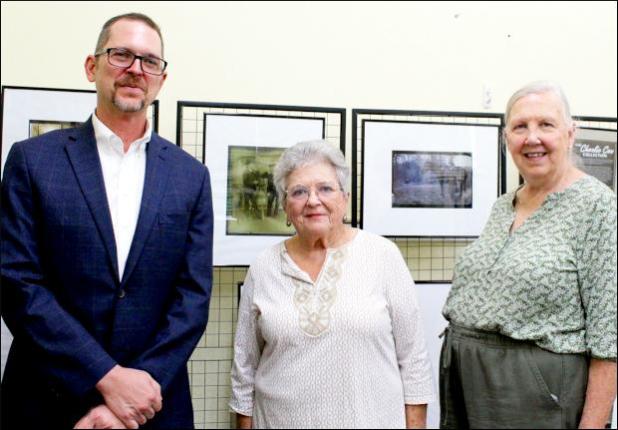
Bob Bakken/South ReporterFrom left, Ole Miss audio-visual librarian Joe Moody, Cox's granddaughter and family historian Judy Cox Andrews, and Judy Goddard with the Benton County Historical and Genealogical Society with some of the images of photographer Charlie Cox on display at the County Museum in Ashland through Nov. 7.
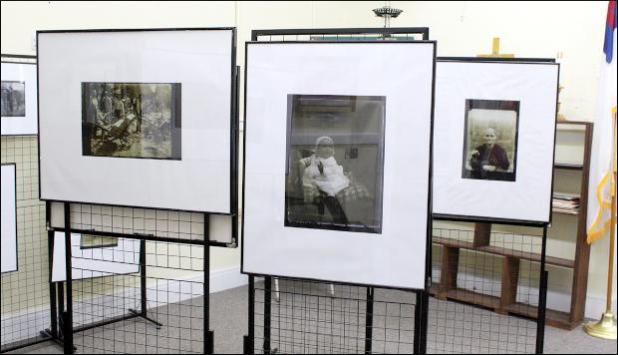
Bob Bakken/South ReporterSome of the images from photographer Charlie Cox on display at the Benton County Museum in Ashland.
Picturing history
For more than a century, an irreplaceable window into early 20th-century North Mississippi sat tucked away inside an unconditioned loft, exposed to wasps and dirt daubers. Today, those fragile glass plates have returned home.
The photographic work of Charlie Whitfield Cox (1881-1946) is on display at the Benton County Historical Museum, housed in the historic courthouse in Ashland. Running through Nov. 7, the exhibition showcases portraits and candid scenes capturing rural life from roughly 100 to 125 years ago.
Cox, an itinerant photographer, farmer and skilled gunsmith who lived his entire life on Liberty Road in Ashland, traveled across the area documenting everyday residents.
“I called them, `We’ve brought Charlie Cox home’ so the people in the county can see them,” said Judy Goddard of the Benton County Historical and Genealogical Society. The society coordinated with Cox’s family and the University of Mississippi to bring the exhibit to Ashland after it was featured on campus.
Goddard noted that visitors have marveled at the glass plates’ survival and the rare cross section of rural life they depict.
“At that time everybody was poor,” Goddard said. “We are able to look back into the county’s history and to see how they lived, what type of activities they engaged in, how they dressed, and the importance they placed on their children.”
The images survived largely thanks to Cox’s granddaughter and family historian, Judy Cox Andrews, who served as their caretaker for four decades after finding them in the loft, where they had sat for about 80 years.
Andrews carefully cleaned the glass using a beaver-hair brush, dried them and preserved them until digital technology made wide-scale restoration possible.
“I don’t think that my family or my grandfather ever dreamed of how much impact it could have and the historical value,” Andrews said. “Realizing that some of us were related when we didn’t even realize it, it’s really exciting.”
The collection was later digitized by Joe Moody, audio-visual librarian at the University of Mississippi. Moody constructed a custom setup utilizing an overhead camera and light board
to digitize the cracked plates and broken slivers, preserving their archival authenticity. The complete digital collection is accessible worldwide via the university’s eGrove digital repository.
“Charlie Cox was a unique photographer,” Moody said, emphasizing the value of seeing the collection in the community where it originated. “It’s rare that we have images like this in this time period in such a small town.”
The exhibit opened Sept. 30 and continues through Nov. 7 at the museum in Ashland.