
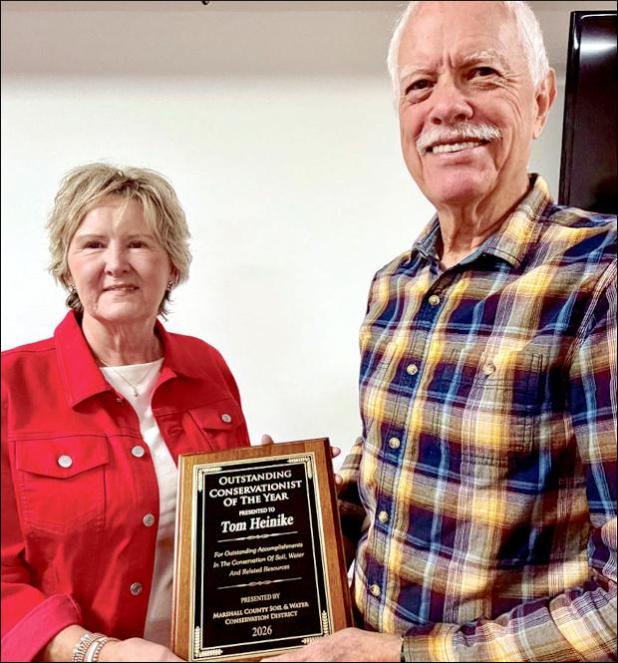
Bob Bakken/South ReporterAnita Cowan, Marshall County Soil and Water Conservation District Commission Chairman, presents Thomas Heineke the Outstanding Conservationist of the Year award during the district's annual meeting Oct. 22 in Holly Springs.
Evening celebrates conservation
Conservation efforts, agricultural economics, and the ongoing battle against invasive pests took center stage Thursday evening, Oct. 22, during the Marshall County Soil and Water Conservation District annual meeting in Holly Springs.
The highlight of the evening at the event was the presentation of the Conservationist of the Year award to Thomas Heineke. The Heineke family was praised for their long-standing dedication to land stewardship, noting their implementation of prescribed burning, pollinator habitats, and wildlife planting. Heineke also recently secured an Environmental Quality Incentives Program (EQIP) contract for a high tunnel to assist with specialty crop production. Upon receiving his plaque, Heineke thanked the district for its support.
Updates from the Natural Resources Conservation Service were provided by Soil Conservationists Collin Ankton and Debreanna Taylor. Both professionals serve the region by educating the community and connecting producers with federal conservation funding. Taylor detailed the agency’s history, noting it was formed as the Soil Conservation Service in 1935 following the devastation of the Dust Bowl. Ankton highlighted key ongoing initiatives, including EQIP and the Conservation Stewardship Program, which offer financial assistance to landowners for implementing sustainable practices.
Marshall County Extension Office County Coordinator Lemon Phelps delivered an agricultural economic update, noting that while cattle prices remain historically high, they have dropped 7 to 10 percent from their recent peak. Phelps emphasized the tight supply in the cattle market, pointing out that the current 32.9 million calf crop is the smallest recorded since 1951. He also issued a stark warning to local producers about the pasture mealybug, a new invasive insect spreading across the Southeast that can easily hitch a ride on farm equipment.
State-level conservation efforts were also a focal point. Reagan West, North Area Field Representative for the Mississippi Soil and Water Conservation Commission, shared that the organization continues to provide assistance to all 82 districts across the state. West highlighted the commission’s educational initiatives, including a youth conservation camp held in June and an upcoming endowment drawdown that will help fund $70,000 in college scholarships for students majoring in natural resource fields.