
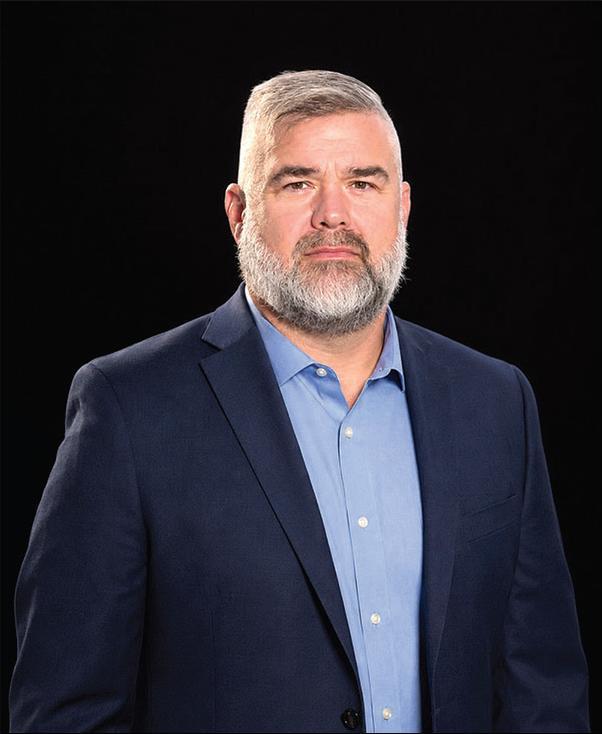
Courtesy photoNew HSUD general manager Paul Michael
City hires general manager for HSUD
Paul Michael, of Sheffield, Alabama, has been hired as general manager of the Holly Springs Utility Department (HSUD). His first day on the job is Sept. 21.
Michael was one of about 20 applicants for the position whose duties have been filled by Holly Springs Mayor Charles Terry, who doubled as mayor and general manager soon after coming on as mayor in July 2024.
Michael has 20 years experience in the utility business.
He and his wife Kristin are the parents of Kaden, 19, and Cooper, 14.
Michael will relocate to the Holly Springs area and there will be a transition process as he wraps up his responsibilities at Sheffield Utilities where he has served as GIS Administrator since 2020.
He was offered the position by the Holly Springs Board of Aldermen in recent months and was among a field of about 20 applicants for the job, according to Jerrica Jones, City Clerk. She said Michael was among the final five selected for interviews and has experience in all departments at the HSUD – gas, electric, water and sewer.
Michael was offered the position in part because of his experience working with electric, gas and water/sewer utilities, she said.
The national search for a general manager was conducted by the Tennessee Valley Public Power Association.
Michael said he is aware of the conditions at the HSUD and gave careful, thoughtful consideration before filing his application for general manager.
“I am aware that HSUD faces serious operational, financial and infrastructure challenges across its electric, gas, water and sewer systems,” he said. “I do not want to make promises about a timeline until I have had the opportunity to fully assess the system and understand what needs to be addressed first.”
Michael submitted a 30-, 60- and 90-day action plan during his interview.
The plan focuses on stabilizing operations, improving safety and reliability and reviewing finances and maintenance needs, restoring accountability and developing a prioritized capital and maintenance plan.
“Stabilization must come first,” he said. “Rebuilding and modernizing the electric system will be a multi-year effort based on engineering needs, available funding and the areas of greatest risk.
“We will not fix everything on Day One, but on Day One, the standard changes.” He said his expectations are centered around the four principles of trust, reliability, accountability and discipline.
“Safety will always come first,” he said. “At the end of every workday the goal is simple – everyone goes home safely.”
Michael will be working alongside HSUD consultant Michael Watson, who was appointed as receiver by Justice Court Chancellor Larry Little at a recent hearing brought forth by the Public Service Commission.
Michael said he accepted the offer for the position of general manager because he believes he can help the HSUD and the communities it serves.
“My commitment is to the utility, its employees and its customers,” he said. “I will need to know the reporting structure and my responsibilities, but I will work professionally with whoever the court places in authority.”
Michael’s longest service is with Florence Electricity where he worked from 2012 to 2020. He has been with Sheffield Utilities since 2020.
He has experience with many types of challenges similar to those facing HSUD such as major outages, storm restoration, rolling blackouts, aging infrastructure, technology changes and challenges involving coordination across departments.
“However, I would not claim that any single situation involved the same combination or scale of issues now facing HSUD,” he said. “What I bring is experience across many areas of utility operations, along with a willingness to confront problems directly, build the right team and establish consistent operating standards.”
Michael wants employees and customers to know he is coming to the HSUD with the intention of moving forward, not blaming anyone for the past.
“I want employees and customers to know we will not dwell on the past or point fingers. I’m coming to listen, understand the problems and work with employees to move the utility forward,” he said. “Every customer, whether inside the Holly Springs city limits, or elsewhere in the HSUD service territory, deserves reliable service, clear communication and to know their concerns matter.
“Rebuilding trust will take time and there will be difficult decisions ahead. I am simply asking for the opportunity to earn that trust through hard work, consistent follow-through and results people can see. I am looking forward to getting started.”
Michael’s employment background and education include: •More than 20 years of experience in the utility industry.
•Currently serves as GIS Administrator at Sheffield Utilities.
•Previously served as GIS and Dispatch Supervisor at Florence Electricity.
•Experience involving electric, natural gas and water utilities.
•Extensive work with outage management, storm response, dispatch, AMI, GIS, customer information systems and field operations.
•Executive MBA and Master of Professional Studies in Information Systems from the University of North Alabama.
•Certified GIS Professional and FAA-licensed remote pilot.
•Experience working within TVA-served municipal utilities.
Michael Watson, who has been named by Chancellor Larry Little as receiver for the HSUD, provided this additional information.
Watson said he will stay on at the HSUD as a consultant.
The Aug. 17 arbitration hearing in Chancery Court will finalize the debt repayment plan for HSUD, he said.
There has been no contract let for installing new meters at the utility.
“Collections are running significantly above last year,” Watson said. “HSUD hired Kendall Vegetation Services to trim vegetation from a circuit in north Benton County.”
That work will be paid for by money available in a $500,000 legislative appropriation to the Tennessee Valley Authority for right-of-way vegetation removal.
A request the HSUD submitted to TVA Aug. 1 for a rate change was withheld by the TVA.
Watson said TVA did not provide a reason for rejection of the rate increase.
“Each month delay (of the rate increase) is $200,000 in foregone revenue,” Watson said.